

The essence of leadership style theories is that a successful leader will exhibit a pattern of behaviour (i.e. ‘style’) in gaining the confidence of those they wish to lead. Style is a difficult factor to measure or define. The style of a manager is essentially how he or she operates, but it is a function of many different factors.
The research at Ashridge Management College distinguished four main management styles:
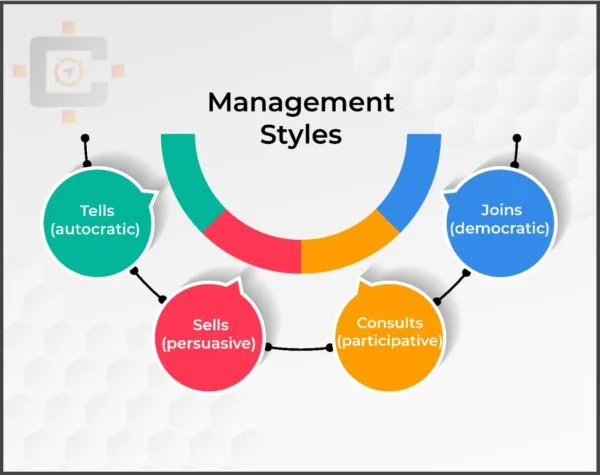
Tells (autocratic) – the manager makes all the decisions and issues instructions which are to be obeyed without question.
Sells (persuasive) – the manager still makes all the decisions, but believes that team members must be motivated to accept them in order to carry them out properly.
Consults (participative) – the manager confers with the team and takes their views into account, although still retains the final say.
Joins (democratic) – the leader and the team members make the decision together on the basis of consensus.
The essence of leadership style theories is that a successful leader will exhibit a pattern of behaviour (i.e. ‘style’) in gaining the confidence of those they wish to lead. Style is a difficult factor to measure or define. The style of a manager is essentially how he or she operates, but it is a function of many different factors.
The research at Ashridge Management College distinguished four main management styles:
Tells (autocratic) – the manager makes all the decisions and issues instructions which are to be obeyed without question.
Sells (persuasive) – the manager still makes all the decisions, but believes that team members must be motivated to accept them in order to carry them out properly.
Consults (participative) – the manager confers with the team and takes their views into account, although still retains the final say.
Joins (democratic) – the leader and the team members make the decision together on the basis of consensus.
Ashridge discovered that most people preferred operating under the ‘consults’ style, though the most important thing was consistency – staff disliked it when managers changed between different styles.
Lewin worked with similar categories and concluded that in terms of productivity and satisfaction, it was the democratic style that was the most productive and satisfying. On the other hand, an autocratic authoritarian style was the least productive of all and carried with it lots of frustration and instances of aggression among group members.
For example, you could argue that Warren Buffett (an extremely successful and high profile investor) has a hands-off, laissez-faire management style that is highly successful because he focuses on hiring very capable people, and the autonomy of these executives is key to the success. On the other hand, Steve Jobs (Apple) was well known for his authoritarian approach and reluctance to delegate, so could be described as having an autocratic approach. Lewin’s work indicated that this style was the least effective, but according to Forbes, Apple was the largest tech company in the world in 2017, and also the 9th largest company in the world.
This lesson is waiting for its secure Vimeo video.


