
A risk map helps companies identify and prioritize the risks associated with their business.
The entire map can be considered the organization’s risk universe, or the set of all the risks faced by the organization.
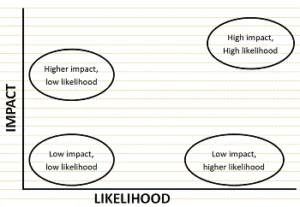
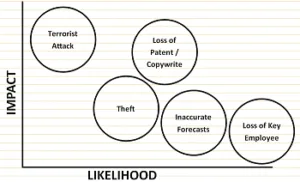
The map identifies whether a risk will have a significant impact on the organisation and links that into the likelihood of the risk occurring.
Risks with a significant impact and a high likelihood of occurrence need more urgent attention than risks with a low impact and low likelihood of occurrence.
Risk Map:
– Writing down a list makes it difficult to really assess which risks are significant.
– A risk map helps companies identify and prioritize the risks associated with their business.
– The entire map can be considered the organization’s risk universe, or the set of all the risks faced by the organization.
– The map identifies whether a risk will have a significant impact on the organisation and links that into the likelihood of the risk occurring.
– Risks with a significant impact and a high likelihood of occurrence need more urgent attention than risks with a low impact and low likelihood of occurrence.
– The significance and impact of each risk will vary depending on the organisation:
– For example, an increase in the price of oil will be significant for airline company but will have almost no impact on a financial services company offering investment advice over the internet.
Dynamic Nature of Risk:
– Risks change over time.
– The environments that companies operate within (both internal and external) vary with respect to the degree of change that is faced.
– In a dynamic environment these changing risks will lead to the assessment of probability and impact in the risk map constantly altering.
Risk Perception:
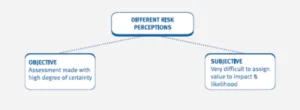
– Objective Assessment: Assessment made with high degree of certainty.
– Subjective Assessment: It is the tendency of the people to have different estimates of the risk probability and its likelihood given the same information.
Risk Map:
Risk Perception: