

Big Data
Big data is a term for a collection of data which is so large that it becomes difficult to store and process using traditional databases and data processing applications.
Cloud Computing
Cloud computing is computing based on the internet. It avoids the need for software, applications, servers and services stored on physical computers. Instead, it stores these with cloud service providers who store these things on the internet and grant access to authorised users.
Artificial Intelligence:
Artificial Intelligence is an area of computer science that emphasises the creation of intelligent machines that work and react like human beings.
Some of the activities that computers with artificial intelligence are designed for include:
- Voice recognition
- Planning
- Learning
- Problem solving
Machine learning:
Most recent advances in AI have been achieved by applying machine learning to very large data sets. Machine learning algorithms detect patterns and learn how to make predictions and recommendations by processing data and experiences, rather than by explicit programming instruction. The algorithms themselves then adapt to new data and experiences to improve their function over time.
Big Data
What is big data?
Big data is a term for a collection of data which is so large that it becomes difficult to store and process using traditional databases and data processing applications.
Big data often also includes more than simply financial information and can involve other organisational data (both internal and external) which is often unstructured.
Examples of data that inputs big data systems can include:
– Social network traffic
– Web server logs
– Streamed audio content
– Banking transactions
– Web page histories and content
– Government documentation
– Financial market data
The features of big data:
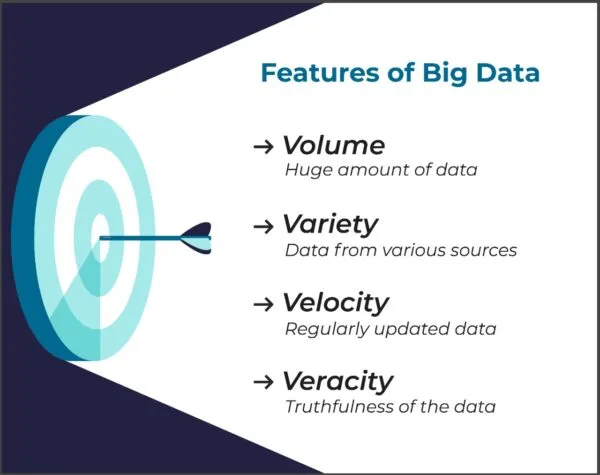
According to Gartner, Big Data can be described using ‘3Vs’:
- Volume – this refers to the significant amount of data that the organisation needs to store and process. Match.com (an online dating company) estimates that it has 70 terabytes of data about its customers.
- Variety – big data can come from numerous sources. For example, Match.com (with user permission) also gathers data on users’ browser and search histories, viewing habits and purchase histories to build an accurate view of the sort of person the customer might like to date.
- Velocity – data is likely to change on a regular basis and needs to be continually updated. For Match.com, new customers will join the service, or existing customers will find their needs and wants from a partner may change. Match.com needs to continually gather data to ensure that they are able to deal with this.
Another V which is sometimes added by organisations to the above list:
- Veracity (truthfulness) – it is vital that the organisation gathers data that is accurate. Failure to do so will make analysis meaningless. Match.com has found that when gathering customer data, customers may lie to present themselves in the most positive light possible to prospective partners. This will lead to inaccurate matches. Using non-biased sources of information (such as purchasing or web browser histories) rather than relying on customer feedback is therefore important.
Benefits of big data:
Big data has several stated benefits to the organisation, including:
– Driving innovation by reducing the time taken to answer by business questions and therefore make decisions.
– Gaining competitive advantage by identifying trends or information that has not been identified rivals.
– Improving productivity by identifying waste and inefficiency, or identifying improvements to working procedures.
Cloud Computing
Cloud computing is computing based on the internet. It avoids the need for software, applications, servers and services stored on physical computers. Instead, it stores these with cloud service providers who store these things on the internet and grant access to authorised users.
Benefits of cloud computing to the organisation:
- Store and Share data – cloud services can often store more data than traditional, logical physical drives, and the data can be shared more easily (regardless of physical location)
- On – demand self –service – users can gain access to technology on demand. For example, every time you download an app from iTunes or the Play store you are downloading it from a cloud service where it is stored.
- Flexibility – work can be done more flexibly as employees no longer need to be ‘plugged into’ work networks or facilities to access the data they need.
- Collaboration – the cloud facilities better workforce collaboration – documents, plans etc. Can be worked on by many different users simultaneously.
- More competitive – smaller firms can get access to technology and services that, without significant financial investment, may otherwise only be available to the largest organisations. This can allow small organisations to compete better with larger rivals.
- Easier scaling – cloud services provide high levels of flexibility in terms of size, number of authorized users etc. This means that the service can grow as the business grows, and allows businesses to scale up much more easily.
- Reduce maintenance – there is no longer need on the part of the organisation for regular maintenance and (security or software) updates of IT service; the cloud provider will take care of this.
- Back-ups – it can be used to back up data. This adds an extra layer of security and removes the need for physical devices to store backed-up data.
- Disaster recovery – this means that it can also aid disaster recovery. Using cloud technology makes this faster and cheaper.
- Better security – the cloud can increase security of data. For example, if in the past an employee were to lose a laptop with sensitive data on it, this would be a high-risk security event for the organisation. Keeping data stored in the cloud should reduce such risks associated with hardware.
Artificial Intelligence:
Artificial Intelligence is an area of computer science that emphasises the creation of intelligent machines that work and react like human beings.
Some of the activities that computers with artificial intelligence are designed for include:
– Voice recognition
– Planning
– Learning
– Problem solving
Machine learning:
Most recent advances in AI have been achieved by applying machine learning to very large data sets. Machine learning algorithms detect patterns and learn how to make predictions and recommendations by processing data and experiences, rather than by explicit programming instruction. The algorithms themselves then adapt to new data and experiences to improve their function over time.
Artificial intelligence and accountancy:
Despite the dramatic recent evolution in artificial intelligence techniques such as machine learning, and the fast pace of its development, widespread adoption of the concept in the financial words is still in its relatively early stages.
It is evident that, in many cases, systems can carry out tasks that result in far more accurate and consistent outputs that could be achieved by humans.
AI brings many opportunities for accountants to improve their efficiency and deliver more value to businesses. In the longer term, AI brings opportunities for more extensive developments, as systems increasingly carry out decision – making tasks that would otherwise be carried out by humans.
There is no doubt that AI will contribute to significant beneficial changes across all areas of accounting. It will equip accountants with powerful new capabilities, as well as enabling machines to deal with an increasing number of tasks and judgements.
Examples include using machine learning:
– To code accounting entries
– To recognise what constitutes ‘normal’ activities in order to improve fraud detection.
– To forecast revenues with the use of predictive models.
– To improving access to, and analysis of, unstructured data, such as contracts, emails and multimedia content.
Having identified many of the opportunities that AI can bring to the accountancy profession, we must appreciate that machines will never act as a direct replacement for human intelligence. The ways in which humans and computers can work together in the most efficient way is therefore a key consideration.


