

A joint venture is formed through an agreement or legal partnership between firms. Companies will separately exist on their own and a new separate entity will be formed for a specific task or business venture.
A joint venture is formed through an agreement or legal partnership between firms. Companies will separately exist on their own and a new separate entity will be formed for a specific task or business venture.
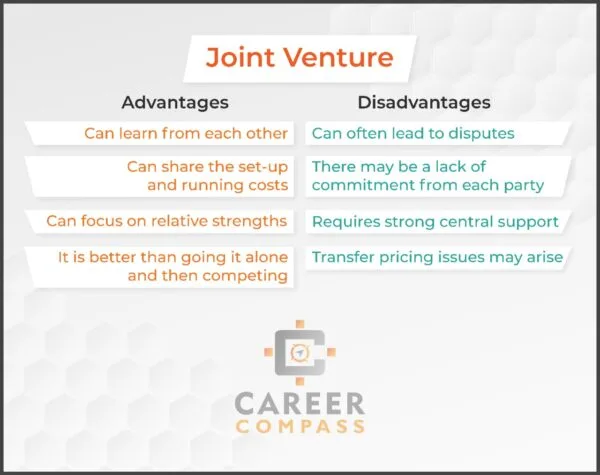
Advantages:
– Can share the set-up and running costs
– Can learn from each other
– Can focus on relative strengths
– May reduce political or cultural risks
– It is better than going it alone and then competing
Disadvantages:
– Can often lead to disputes
– May give access to strategic capabilities and eventually allow the partner to compete in core areas
– There may be a lack of commitment from each party
– Requires strong central support which may not be provided
– Transfer pricing issues may arise and performance appraisal can be complicated
Maruti Suzuki – Maruti had a Production plant and Suzuki had the technology so they both jointly agreed and formed a joint venture for India.
Google parent company and the pharma company Glaxo and Smith decided to enter into a joint venture agreement to produce bioelectric medicines the ratio of the ownership was 45%-55%. The joint venture lasted and was committed for 7 years with a capital of Euro 540 million.
Another example of a joint venture is the joint venture between the taxi giant UBER and the heavy vehicle manufacturer Volvo. The joint venture goal was to produce driverless cars the ratio of the ownership is 50%-50%. The business worth was $350 million as per the agreement in the joint venture.
This lesson is waiting for its secure Vimeo video.


