

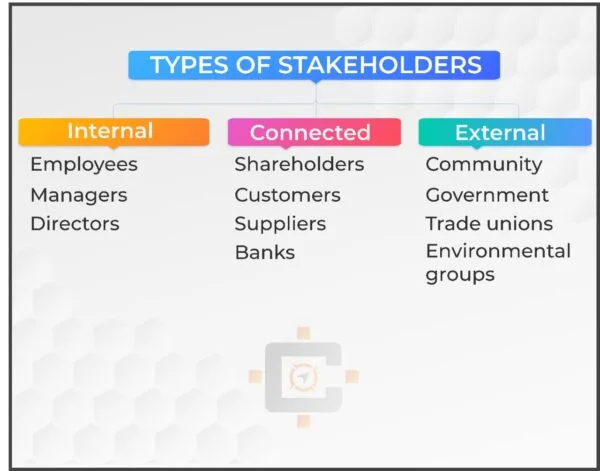
Internal stakeholders:
These are any stakeholders that are within the organisation itself. Their objectives are likely to have a strong influence on how it is run.
Connected stakeholders:
Connected stakeholders either invest in or have dealings with the firm.
External stakeholders:
These stakeholders tend to not have a direct link to the organisation, but can influence or be influenced by its activities.
1. Internal stakeholders:
These are any stakeholders that are within the organisation itself. Their objectives are likely to have a strong influence on how it is run.
Internal stakeholders include:
| Stakeholder | Need/expectation |
| Employees | Pay, working conditions and job security |
| Managers/directors | Status, pay, bonus, job security |
2. Connected stakeholders:
Connected stakeholders either invest in or have dealings with the firm.
They tend to have varied objectives:
| Stakeholder | Need/expectation |
| Shareholders | Steady flow of income, possible capital growth and the continuation of the business. |
| Customers | Satisfaction of customers’ needs will be achieved through providing value-for money products and services. |
| Suppliers | Paid promptly |
| Finance providers | Ability to repay the finance including interest, security of investment. |
3. External stakeholders:
These stakeholders tend to not have a direct link to the organisation, but can influence or be influenced by its activities.
As with connected stakeholders, they will have very diverse objectives for the organisation to take account of.
| Stakeholder | Need/expectation |
| Community at large | The general public can be a stakeholder, especially if their lives are affected by an organisation’s decisions. |
| Environmental pressure groups | The organisation does not harm the external environment. |
| Government | Company activities are central to the success of the economy (providing jobs and paying taxes). Legislation (e.g. health and safety) must be met by the company |
| Trade unions | Taking an active part in the decision-making process. |
4. Primary and secondary:
This is a different method of categorising stakeholders, which is based on whether or not they have a contractual relationship with the organisation.
Primary stakeholders are those that have a contractual relationship, for instance employees, directors, shareholders – in fact any stakeholder who falls into the ‘connected’ or ‘internal’ categories which are examined above.
Secondary stakeholders are parties that have an interest in the organisation, but have no contractual link, such as the public. Any stakeholders in the ‘external’ category would fall into this group.
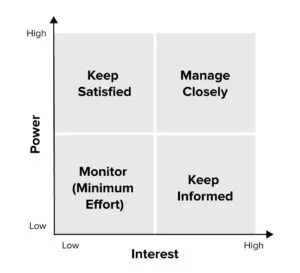
Mendelow’s Stakeholders Mapping Model:
Example of Internal Stakeholders:
– If workers are to be given more responsibility, they will expect increased pay.
– If growth is going to occur, the managers will want increased profits, leading to increased bonuses.
Example of Connected Stakeholders:
– If capital is required for growth, the shareholders will expect a rise in the dividend stream.
– Any attempt to, for example, increase the quality and the price, may lead to customer dissatisfaction.
– If a decision is made to delay payment to suppliers to ease cash flow, existing suppliers may cease supplying goods.
– The firm’s ability to generate cash.
Example of External Stakeholders:
– Local residents’ attitude towards out-of town shopping centers.
– If an airport wants to build a new runway, the pressure groups may stage a ‘sit in’.
– Actions by companies could break the law, or damage the environment, and governments therefore control what organisations can do.
– If a department is to be closed the union will want to be consulted, and there should be a scheme in place to help employees find alternative employment.
This lesson is waiting for its secure Vimeo video.


