

Product issues:
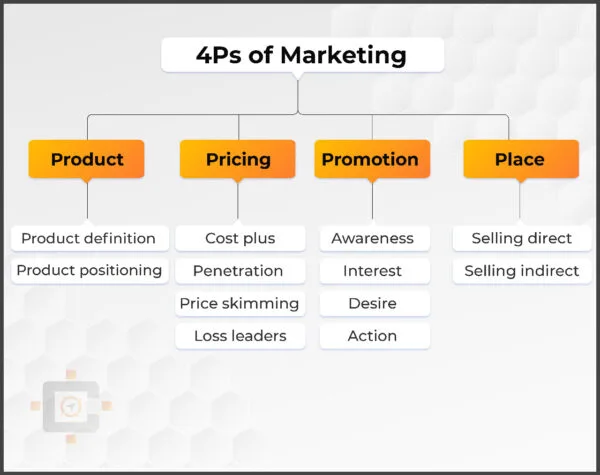
There are two main product issues to consider:
Product definition – The main issue regarding product is to define exactly what the product should be. This can be done on three levels:
– Product positioning – With all of these factors the question of product positioning is critical – how does our product compare with the offerings of competitors? Is our product better? If so, in what way?
Pricing issues:
There are four key considerations (the ‘4Cs’) when deciding the price of a product:
– Cost – the price must be high enough to make a profit.
– Customers – what are they willing to pay?
– Competition – is our price higher than competitors?
– Corporate objectives – e.g. the price could be set low to gain market share.
These issues can be blended to give a range of pricing tactics, including the following:
– Cost plus pricing – the cost per unit is calculated and then a mark-up added.
– Penetration pricing – a low price is set to gain market share.
– Perceived quality pricing – a high price is set to reflect/create an image of high quality.
– Price discrimination – different prices are set for the same product in different markets, e.g. peak/off-peak rail fares.
– Going rate pricing – prices are set to match competitors.
– Price skimming – high prices are set when a new product is launched. Later the price is dropped to increase demand once the customers who are willing to pay more have been ‘skimmed off’.
– Loss leaders – one product may be sold at a loss with the expectation that customers will then go on and buy other more profitable products.
– Captive product pricing – this is used where customers must buy two products. The first is cheap to attract customers but the second is expensive, once they are captive.
Promotional issues:
Promotion is essentially about market communication. The primary aim is to encourage customers to buy the products by moving them along the AIDA sequence:
Awareness
Interest
Desire
Action
Towards this firms will use a combination of different promotional techniques as part of their ‘promotional mix’, including:
– Advertising – e.g. placing adverts on TV, in newspapers, on billboards, etc.
– Sales promotion techniques – e.g. ‘Buy one get one free’.
– Personal selling – e.g. door-to-door salesmen.
– Public relations (PR) – e.g. sponsoring sports events.
Place (distribution) issues:
The key decision under ‘place’ is between:
– Selling direct – here the manufacturer sells directly to the ultimate consumer without using any middlemen, e.g. accountancy firms deal directly with their clients without recourse to brokers or other middlemen.
– Selling indirect – here the channel strategy could comprise a mixture of retailer, distributors, wholesalers and shipping agents, e.g. food distribution will often involve distributors and retailers to get the product from farmer to consumer.
This lesson is waiting for its secure Vimeo video.


