

As part of ‘strategy in action’, a business will create plans for each SBU, product, function etc. These plans are often in the form of budgets. The budget sets out the short-term plans a target necessary to fulfil the longer-term strategic plans and objectives.
The budgets will also play a vital role in reviewing and controlling strategic plans. They will be used to identify and investigate variances and to highlight when a plan or process is ‘out of control’.
Budgets are distinct from forecasts. A forecast is a prediction of a future outcome. A budget is a plan (usually in financial terms) that looks to use and/or achieve that forecast.
As part of ‘strategy in action’, a business will create plans for each SBU, product, function etc. These plans are often in the form of budgets. The budget sets out the short-term plans a target necessary to fulfil the longer-term strategic plans and objectives.
The budgets will also play a vital role in reviewing and controlling strategic plans. They will be used to identify and investigate variances and to highlight when a plan or process is ‘out of control’.
Budgets are distinct from forecasts. A forecast is a prediction of a future outcome. A budget is a plan (usually in financial terms) that looks to use and/or achieve that forecast.
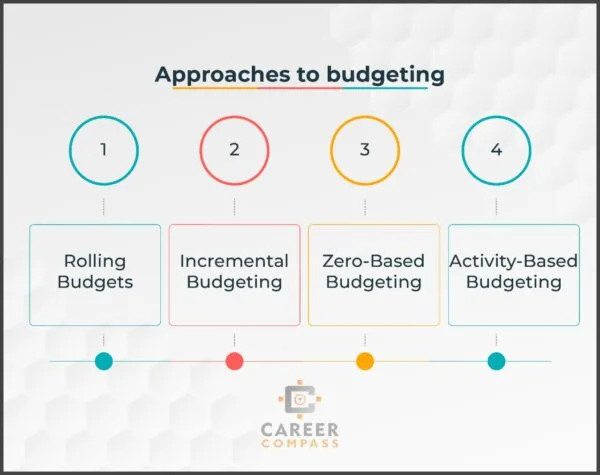
Approaches to budgeting:
A periodic budget shows the costs and revenue for one period of time, e.g., a year and is updated on a periodic basis, e.g., every 12 months. However, there are many different ways in which a budget might be prepared.
Rolling budgets:
A rolling budget is a ‘budget continuously updated by adding a further accounting period (month or quarter) when the earliest accounting period has expired’ (CIMA Official Terminology). Rolling budgets are also called ‘continuous budgets’.
Incremental budgeting:
The traditional approach to budgeting is to take the previous year’s budget and to add on a percentage to allow for inflation and other cost increases. In addition, there may be other adjustments for specific items such as an extra worker or extra machine.
Zero-based budgeting:
Zero-based budgeting (ZBB) is a radical alternative to incremental budgeting. In ZBB, all activities and costs are budgeted from scratch (a zero base). For every activity, managers look at its costs and its purpose, and consider whether there are alternative ways of doing it. Non-essential activities and costs are identified and eliminated, by removing them from next year’s budget.
Activity-based budgeting:
Whereas ZBB is based on budgets prepared by responsibility centre managers, ABB is based on budgeting for activities. In its simplest form, ABB is simply about using costs determined via ABC to prepare budgets for each activity.
ABB is useful when overheads are significant within a business, but it relies on the use of Activity Based Costing which may not be used by all organisations.
Meaningful budgetary control:
Budgetary control refers to not only the budget setting process but also to the monitoring of ongoing performance against these budgets. For this second process to be useful the budgets themselves must be accurate, reliable and up to date.
Behavioural aspects of budgets:
As mentioned above, one of the purposes of budgets is to achieve motivation. There are therefore a number of factors to consider in relation to this:
– The level of difficulty in the budget,
– The links to the organisation’s objectives, and
– The level of staff involvement.
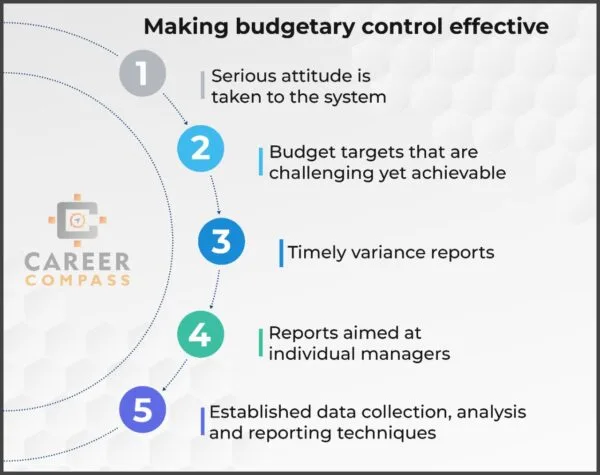
Making budgetary control effective:
Atrill and McLaney identify a number of characteristics that are common to businesses with effective budgetary control:
– A serious attitude is taken to the system
– Clear demarcation between areas of managerial responsibility
– Budget targets that are challenging yet achievable
– Established data collection, analysis and reporting techniques
– Reports aimed at individual managers
– Fairly short reporting periods
– Timely variance reports
– Action being taken to get operations back under control if they are shown to be out of control.
Forecasting in budgets:
It will be necessary to forecast the principal budget factor. This will often require a forecast of future sales.
There are a number of ways in which it might achieve this:
– It may use market forecasts of expected growth and build these into the expected growth in its trend (although this assumes that the organisation will grow at the same rate as the market)
– Mathematical techniques such as linear regression (often compiled on a spreadsheet) can be used to develop an expected linear growth in the trend (although this assumes that the past behaviour will provide an accurate estimate of the expected change in future behaviour).
– The high-low method could be used to forecast the change (though this would suffer from similar problems to the linear regression model, in that it assumes that the trend is linear and will continue to rise at the same rate in the future).
It may be that the forecast needs to account for seasonality. For example, a sporting venue’s hot drinks sales may be higher in the winter than they are in the summer. Time series analysis is a way of building seasonality into forecasts.
This lesson is waiting for its secure Vimeo video.


