

Ansoff matrix is the tool that helps form future growth strategies for leaders of organization.
He describes four growth alternatives for growing an organization in existing or new markets, with existing or new products. Each alternative poses differing levels of risk for an organization
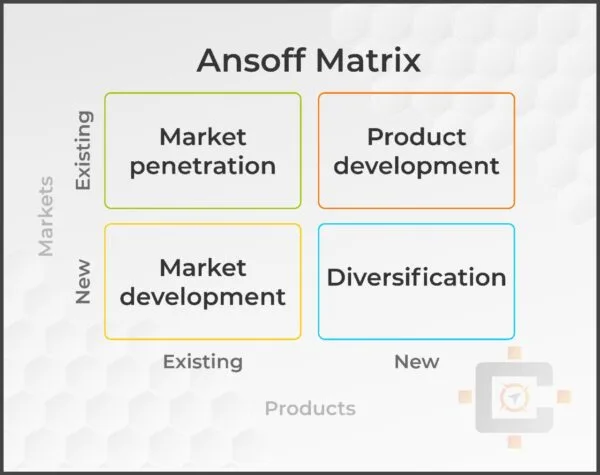
Ansoff matrix is the tool that helps form future growth strategies for leaders of organization.
He describes four growth alternatives for growing an organization in existing or new markets, with existing or new products. Each alternative poses differing levels of risk for an organization:
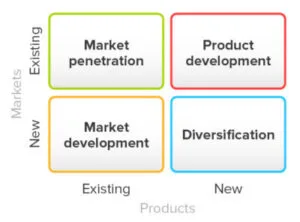
1) Market Penetration:
In market penetration strategy, the organization tries to grow using its existing offerings (products and services) in existing markets. In other words, it tries to increase its market share in current market scenario. This involves increasing market share within existing market segments.
The company seeks increased sales for its present products in its present markets through more aggressive promotion and distribution.
This can be accomplished by:
– Price decrease
– Increase in promotion and distribution support
– Acquisition of a rival in the same market
– Modest product refinements
This is the least risky growth option
2) Market Development:
In market development strategy, a firm tries to expand into new markets (geographies, countries etc.) using its existing offerings and also, with minimal product/services development.
This can be accomplished by:
– Different customer segments
– Industrial buyers for a good that was previously sold only to the households;
– New areas or regions of the country
– Foreign markets.
This strategy is more likely to be successful where:
– The firm has a unique product technology it can leverage in the new market
– It benefits from economies of scale if it increases output
– The new market is not too different from the one it has experience of
– The buyers in the market are intrinsically profitable.
This additional quadrant move increases uncertainty and thus increases the risk further.
3) Product development:
In product development strategy, a company tries to create new products and services targeted at its existing markets to achieve growth. This involves extending the product range available to the firm’s existing markets. These products may be obtained by:
– Investment in research and development of additional products;
– Acquisition of rights to produce someone else’s product;
– Buying in the product and “badging” it as one’s own brand;
– Joint development with ownership of another company who need access to the firm’s distribution channels or brands.
This also consists of one quadrant move so is riskier than Market penetration and a similar risk as Market development.
4) Diversification:
In diversification an organization tries to grow its market share by introducing new offerings in new markets. It is the most risky strategy because both product and market development is required.
Reasons why companies pursue a strategy of international diversification
– There are increasing opportunities from global markets, either where products themselves are becoming global or where the organisation’s customers operate on a global basis.
– If local markets are saturated or limited, it may be possible to sell products into new locations using existing skills and infrastructure.
– Risks may be spread as poor results in one market due to local economic conditions can be balanced against good conditions in another.
– It may be possible to take advantage of particular aspects of different locations and markets such as low labour costs.
1. Market Penetration:
Assume Cadbury Company who produces different types of chocolates. They bring just some changes in their existing product and try to gain revenue from the market. Like producing Cadbury celebrations where chocolates inside the box are same but just brought some changes in its packaging. So here the product and market of Cadbury Company is same, but just brought some minor changes in their existing product.
2. Product Development:
Let’s take example of Samsung Company. We can see much diversification and many new launches of mobile phones. So, here their market is same but brought up new products in the market to gain revenue.
3. Market Development:
Companies like Walmart and Apple. They have same product and same concept but brought up in India. So their product is same but they brought their product into the new market.
4. Diversification:
A Company like Godrej. They initially used to produce products like hair dye, locks etc. But, they started new business of Godrej poultry farms. So, here they will get new set of customers where product and market both are new.
This lesson is waiting for its secure Vimeo video.


