

Risk appetite is the level of risk that an organization is prepared to accept in pursuit of its objectives.
It can be determined by:
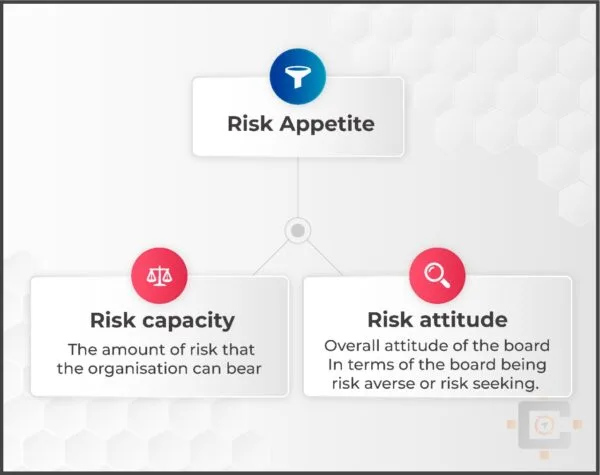
- risk capacity – the amount of risk that the organisation can bear, and
- risk attitude – the overall character of the board, in terms of the board being risk averse or risk seeking.
Risk appetite is the level of risk that an organization is prepared to accept in pursuit of its objectives.
It can be determined by:
– Risk capacity – the amount of risk that the organisation can bear, and
– Risk attitude – the overall character of the board, in terms of the board being risk averse or risk seeking.
There is no easy correlation between the risk appetite of an organisation and its size, structure and development.
In general terms:
– A small, young company may have a higher risk appetite as it takes risks in order to get its product into the market.
– A larger, older company may appear to be more risk-averse as it seeks to protect its current market position.
Assume that currently its been around 11 AM in the morning so we can say we in the middle of Breakfast and Lunch. If I ask you how much hungry you are then you will tell me that I am very hungry, I can eat Large MacD meal.
What you did here is you have translated your hunger feeling with the amount of food you can eat right now. Otherwise the real feeling of hunger can’t be expressed because its feeling and so its intangible.
The same way the concept of Risk appetite concept works that when we ask CEO how much hungry you are to take risk, CEO will answer that with the certain amount. But the appetite is just like the feeling, you are just expressing that feeling with the amount.
The level of risk appetite will impact all the decision making, investment decision, project decision, strategy and all other important things in the organization.
This lesson is waiting for its secure Vimeo video.


