

Transfer:
Risk can be transferred wholly or in part to a third party, so that if an adverse event occurs, the third party suffers all or most of the loss.
Avoid:
An organisation might choose to avoid a risk altogether.
However, since risks are unavoidable in business ventures, they can be avoided only by not investing.
Reduction/Mitigation:
Attempting to decrease the adverse effects should that risk actually crystallize.
There are various mitigation techniques like risk minimization, risk pooling & hedging techniques.
Accept:
Its’s simply accept that the risk may occur and decide to deal with the consequences in that particular situation. The strategy is appropriate normally where the adverse effect is minimal.
The risk management process was described in the previous chapter. We will now move onto the third step of the process: risk planning and formulating the risk management strategies.
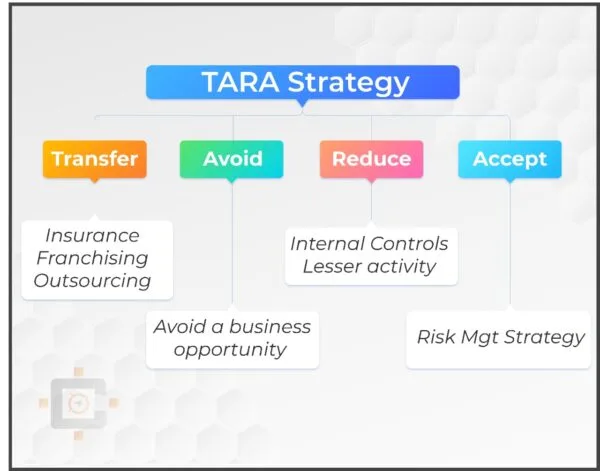
Strategies for managing risks can be explained as TARA (or SARA): Transference (or Sharing), Avoidance, Reduction or Acceptance.
Common Example:
Risk Management (TARA Strategy):
Transfer | – Insurance – Joint Venture to spread risk – Franchising – Outsourcing |
Avoid | – Avoid a business opportunity |
Reduce | – Internal Controls – Lesser activity |
Accept | Deciding on strategy to accept risk/lower returns |
Macdonald Example:
Risk of Increase in the price of raw material is a risk which can have high impact if occurred and so this should be managed properly.
Now this risk may not be possible to transfer to insurance company, but we can share with the franchisee. But still even if it is shared, it will impact Macdonald very badly.
So they have to manage this risk by either contracting with supplier and also by inserting the clause of maximum price increase and intimidating in advance.
They can reduce the risk also by grow they own potatoes and making their own bread.
These is an also the risk of changes in taste and preference. They have to deal with it also, it can’t be transferred.
There is the risk of high labour turnover, they can try to reduce it but they should accept this type of risk because the impact is not much on the organization. They will find the new employees very easily.
There are one more risk with Macdonald is Foreign currency risk. Their most of sales are from foreign countries and they have to something about this exchange rate risk. They can transfer the risk by hedging foreign exchange rate. This way Macdonald can transfer their risk.
This lesson is waiting for its secure Vimeo video.


